
Launching a website has never been easier. Modern website builders, hosting platforms, and ready-made templates allow almost anyone to publish a website within hours. However, the real challenge begins after your website goes live. Without visibility in search engines, even a beautifully designed website with valuable content can remain practically invisible online.
For many website owners, learning SEO for beginners is the first step toward achieving that visibility. Search engine optimization helps websites appear in search results when users actively look for information, products, or services online.
This is where SEO becomes essential. Every day, billions of searches occur on platforms like Google, where users look for answers, solutions, products, and services. Businesses and websites that appear in these results gain a significant advantage—they reach users who are actively searching for what they offer.
For beginners, SEO can feel overwhelming at first. The industry is filled with technical terminology, algorithm updates, ranking factors, and specialized tools. Yet, at its core, SEO is straightforward. Effective SEO means helping search engines understand your content while ensuring that your website genuinely assists users.
This guide introduces the fundamentals of SEO for beginners in a practical and structured way. By the end, you will have a clear understanding of how search engines evaluate websites, how rankings are determined, and what actionable steps beginners can take to improve visibility in search results.
What Is SEO for Beginners?
Search Engine Optimization (SEO) refers to the process of improving a website so that it appears higher in search engine results pages. When users search online, search engines attempt to deliver the most relevant and trustworthy pages that best answer the user’s query. SEO for beginners ensures that your website is structured and optimized in a way that makes it eligible to appear among those results.
At its core, SEO for beginners is about alignment—aligning your website’s content with what users are searching for and with how search engines evaluate web pages.
For example, if someone searches for “best digital marketing strategies for small businesses,” the search engine must analyze thousands of pages to determine which ones provide the most helpful and reliable information. Pages that clearly address the topic, demonstrate expertise, and offer a strong user experience are more likely to rank higher.
Unlike paid advertising, SEO focuses on organic traffic. Organic visitors arrive through natural search results rather than paid placements. Because these visitors are actively searching for information, they are often more engaged and more likely to convert into customers or long-term readers.
Over time, a well-executed SEO for beginners strategy can become one of the most consistent and valuable sources of website traffic.

How Search Engines Work
Understanding SEO for beginners becomes significantly easier when you understand how search engines operate behind the scenes. While search algorithms are highly complex, their basic process can be understood through three fundamental stages: crawling, indexing, and ranking.
Crawling
Search engines rely on automated programs called crawlers to explore the internet. These bots navigate the web by following links from one page to another, discovering new content and revisiting previously indexed pages to detect updates.
Whenever you publish a new webpage or blog post, the search engine must first discover it before it can appear in search results. Internal links, external backlinks, and XML sitemaps help crawlers locate your content more efficiently.
In many ways, crawlers function like digital explorers continuously mapping the internet.
Indexing
Once a page has been discovered, the search engine analyzes its content and stores it within a massive database known as the index. This index functions similarly to a digital library containing information about billions of web pages.
During this process, search engines examine various elements such as page content, images, headings, metadata, and site structure. If the page meets quality standards and can be properly interpreted, it becomes eligible to appear in search results.
Pages with technical issues or unclear content may struggle to be indexed effectively.
Ranking
Ranking occurs when a user enters a search query. The search engine scans its index and determines which pages best match the intent of the search.
Hundreds of factors influence this decision, including content relevance, website authority, user experience, page speed, and many other signals. Pages that demonstrate strong performance across these factors are more likely to appear near the top of search results.
The objective of the search engine remains simple: deliver the most useful answer to the user as quickly as possible.

Understanding the Types of SEO
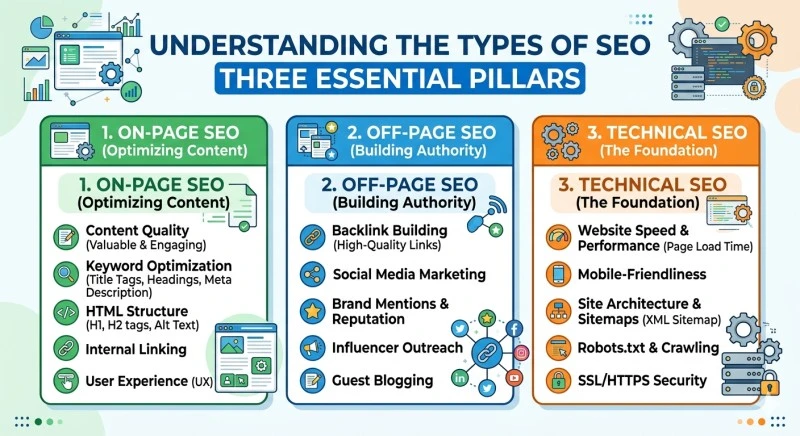
SEO strategies are commonly divided into three primary categories: on-page SEO, off-page SEO, and technical SEO. Each of these areas focuses on a different aspect of how search engines evaluate and rank websites.
Understanding these three pillars is important for beginners because successful SEO for beginners rarely depends on just one factor. Instead, it requires a balanced approach that combines high-quality content, website credibility, and strong technical performance. When all three elements work together, search engines can more easily understand your website and determine whether it deserves visibility in search results.
On-Page SEO
On-page SEO focuses on optimizing the content and structure of individual pages on your website. The primary objective is to ensure that both users and search engines clearly understand what the page is about.
This involves carefully crafting elements such as page titles, headings, meta descriptions, and content structure. Keywords also play an important role, as they help search engines connect your content with relevant search queries. However, modern SEO is no longer about inserting keywords repeatedly. Instead, the goal is to use them naturally while providing helpful and meaningful information.
For instance, a blog about SEO for beginners should explain the topic clearly, include relevant headings, and provide useful insights that answer common questions. Internal linking to related articles improves navigation and helps search engines understand the relationships between pages.
Internal linking is another key component of on-page SEO. Linking to related articles within your website helps guide readers to additional information while also helping search engines understand how different pages on your site are connected.
When on-page SEO is implemented properly, it improves both readability for users and clarity for search engines, increasing the chances that the page will rank for relevant searches.
Off-Page SEO
While on-page SEO focuses on improvements made within your own website, off-page SEO refers to external signals that influence how search engines evaluate your site’s credibility and authority.
The most important factor in off-page SEO is backlinks. Backlinks are links from other websites that point to your content. Search engines view these links as signals of trust. When respected websites link to your content, that suggests SEO for beginners strategies are being effectively applied.
For example, if a popular marketing blog references your article as a useful resource, that link strengthens your website’s reputation in the eyes of search engines.
However, not all backlinks carry the same value. Links from reputable and authoritative websites are far more impactful than links from low-quality or unrelated sites. Because of this, modern link-building strategies focus on earning quality links rather than simply increasing the number of links.
Common ways to build backlinks include creating high-value content, writing guest posts on industry blogs, collaborating with other websites, and publishing research or in-depth guides that others naturally want to reference.
Over time, a strong backlink profile helps establish your website as a trusted source within your industry.
Technical SEO
Technical SEO focuses on the behind-the-scenes infrastructure of your website. While visitors may not directly notice these technical elements, they play a crucial role in how search engines crawl, interpret, and index your pages.
One important aspect of technical SEO is website speed. Pages that load quickly provide a better user experience and are more likely to retain visitors. Slow-loading websites, on the other hand, often lead to higher bounce rates, which can negatively impact rankings.
Mobile responsiveness is another key factor. Since a large portion of internet traffic now comes from mobile devices, search engines prioritize websites that function smoothly on smartphones and tablets.
Website security also contributes to technical SEO. Websites that use HTTPS encryption provide a safer browsing experience and are generally considered more trustworthy by search engines.
Another important component is site architecture. A well-organized website with clear navigation allows both users and search engines to easily understand how pages are connected. When search engines can efficiently crawl and interpret your site, it becomes easier for them to index your content and display it in relevant search results. This is a crucial step in SEO for beginners.
For beginners, technical SEO may seem intimidating at first, but addressing basic factors like site speed, mobile optimization, and clear navigation can make a significant difference in overall search performance.
Keyword Research Basics
Keyword research sits at the center of nearly every successful SEO strategy. Keywords represent the phrases and questions that users type into search engines when seeking information.
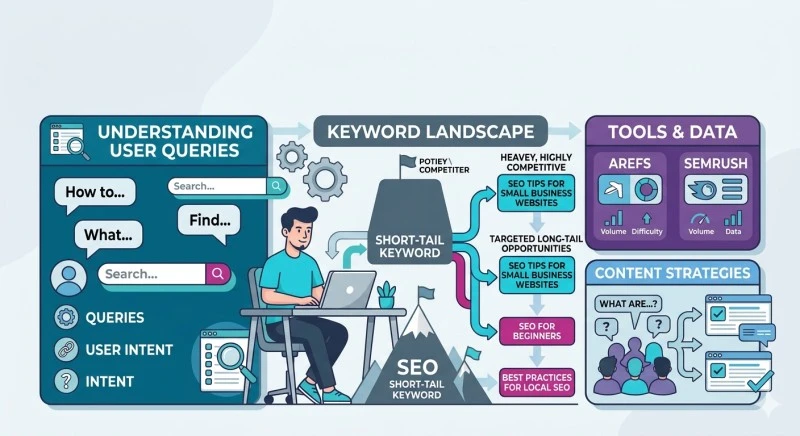
Understanding these queries allows you to create content that directly addresses the needs of your audience. Beginners who focus on SEO for beginners techniques can target the right keywords efficiently. For beginners, long-tail keywords often present the best opportunity. These are more specific search phrases that typically have lower competition and clearer search intent.
For example, attempting to rank for the keyword “SEO” would be extremely challenging due to intense competition. However, targeting a phrase such as “SEO tips for small business websites” provides a more focused opportunity.
Professional SEO specialists frequently rely on tools like Ahrefs and SEMrush to analyze search volume, keyword difficulty, and ranking opportunities.
Even without advanced tools, beginners can start by identifying common questions their audience asks and creating content that provides thoughtful and comprehensive answers.
On-Page SEO Optimization
Once you have identified the right keywords, the next step is integrating them naturally within your content.
A strong title tag is one of the most important on-page SEO elements. It communicates the topic of the page while encouraging users to click when they see it in search results. Headings also play a critical role. Well-structured headings organize the content into logical sections, making the article easier to read while helping search engines interpret the structure of the page.
Content quality remains the most important factor. Pages that provide clear explanations, useful insights, and actionable guidance are far more likely to satisfy users and perform well in search rankings.
Internal linking also strengthens on-page SEO. By linking to relevant pages within your website, you help users discover additional content while guiding search engines through your site’s structure.
Technical SEO Basics
Technical SEO ensures that your website performs efficiently from a structural and performance standpoint. One of the most important technical factors is page speed. Slow websites create a poor user experience and often lead to higher bounce rates.
Mobile usability is equally important. Since a majority of searches now occur on mobile devices, search engines prioritize websites that function smoothly on smaller screens. Security also plays a role. Websites using HTTPS encryption are considered safer and more trustworthy.
Finally, site architecture influences how easily search engines understand your website. Clear navigation and logical content organization help both users and search engines navigate the site effectively.
Link Building Basics
Link building remains one of the most influential elements of SEO.
When other websites link to your content, they send a signal to search engines that your page offers value. However, the quality of these links matters far more than the quantity. Links from reputable, authoritative websites carry significantly more weight than links from low-quality or irrelevant sources.
One of the most effective strategies for earning backlinks is creating high-value content that others naturally want to reference. Comprehensive guides, research-based articles, and insightful industry content often attract links organically.
Guest blogging and industry collaborations can also create opportunities to earn relevant backlinks while building professional relationships.
Over time, a strong backlink profile strengthens your website’s credibility and improves its ability to rank in search results.
Important SEO Tools
While SEO knowledge forms the foundation of success, tools can significantly improve efficiency and insights. Beginners learning SEO for beginners rely on these tools to monitor and enhance performance.
One of the most valuable free tools available to website owners is Google Search Console. It allows you to monitor search performance, identify indexing issues, and track keyword visibility.
Another essential platform is Google Analytics, which provides detailed insights into website traffic, user behavior, and engagement patterns. For deeper competitive analysis and keyword research, many professionals use tools such as Ahrefs and SEMrush.
These tools provide valuable data that can guide content strategies and reveal opportunities for growth.
Common SEO Mistakes
Many beginners approach SEO with enthusiasm but unknowingly make mistakes that limit their results. One of the most common errors is overusing keywords. Modern search engines prioritize content quality and readability, making keyword stuffing ineffective and potentially harmful.
Another frequent issue is misunderstanding search intent. If a user searches for a guide but lands on a promotional page, the mismatch often leads to poor engagement.
Technical issues can also create problems. Broken links, slow loading speeds, and poor mobile optimization may prevent search engines from properly evaluating your content. Focusing on user experience and consistent content quality helps avoid many of these pitfalls.
The Future of SEO
SEO continues to evolve as search technology becomes more sophisticated. Advances in artificial intelligence and machine learning allow search engines to interpret context, intent, and language more accurately than ever before.
Rather than focusing purely on keywords, modern algorithms increasingly evaluate whether content genuinely helps users solve problems. This shift means that the future of SEO will place even greater emphasis on expertise, authority, and trustworthiness.
Websites that prioritize meaningful insights, credible information, and strong user experiences will continue to perform well as search technology advances.
Conclusion
SEO may initially appear complex, but its underlying principles are remarkably straightforward. At its heart, SEO is about understanding what people are searching for and delivering content that genuinely helps them.
For beginners, the most effective strategy is to focus on the fundamentals. Learn how search engines work, research topics your audience cares about, and create high-quality content that answers their questions clearly.
As your website grows and earns credibility, these efforts can generate sustainable organic traffic and long-term visibility.
In an increasingly competitive digital environment, visibility often determines success. Investing time in learning and applying SEO is therefore not just a marketing tactic—it is a long-term strategy for building a strong and discoverable online presence.
FAQs
1. What is SEO for beginners and why is it important?
SEO, or Search Engine Optimization, is the process of optimizing your website to rank higher in search results. For beginners, it’s essential because it helps your site get noticed by people actively searching for your products, services, or information. Without SEO, even great content can stay invisible.
2. How do search engines work and why should I care?
Search engines use crawlers to discover content, index pages in a database, and rank them based on relevance, authority, and user experience. Understanding this helps beginners structure their site and content so search engines can easily interpret it, improving ranking chances.
3. What are the main types of SEO I should focus on?
SEO has three types: on-page, off-page, and technical. On-page optimizes your content and keywords, off-page builds backlinks and authority, and technical ensures your site runs fast and mobile-friendly. Beginners should balance all three for effective results.
4. How do I choose the right keywords for my website?
Keyword research helps you find what your audience searches for. Long-tail keywords like “SEO tips for small businesses” are easier to rank for than broad terms like “SEO.” Tools like Ahrefs, SEMrush, or Google Keyword Planner can guide you toward the best options.
5. What is on-page SEO and how can I implement it?
On-page SEO optimizes your content for both users and search engines. Include keywords naturally, structure headings, craft strong title tags and meta descriptions, and link internally to related pages. Good on-page SEO improves readability and ranking.
6. What is off-page SEO and why does it matter?
Off-page SEO focuses on external signals like backlinks from reputable websites. Quality backlinks show search engines your site is trustworthy and valuable, improving your rankings.
7. How important is technical SEO for beginners?
Technical SEO ensures your site runs smoothly and is crawlable. Key factors include page speed, mobile responsiveness, HTTPS security, and clear site structure. Even beginners can improve rankings by addressing these basics.
8. How long does it take to see results from SEO?
SEO is a long-term strategy. Beginners often see results in 3–6 months, depending on competition, content quality, and consistency. Patience and ongoing effort are essential for sustainable growth.
9. What common SEO mistakes should beginners avoid?
Common mistakes include keyword stuffing, ignoring mobile optimization, low-quality content, and slow websites. Focusing on user experience, content quality, and clear structure helps avoid these pitfalls and improve rankings.
10. What tools can help beginners with SEO?
Free and paid tools simplify SEO. Google Search Console tracks indexing and performance. Google Analytics monitors traffic and behavior. Tools like Ahrefs and SEMrush help with keywords, competitors, and backlinks, guiding smarter decisions.